
The good news: this status signals that the hard part is over. Your claim has been formally reviewed, a coverage determination has been made in your favor, and payment has been approved. The funds are simply queued for the next scheduled disbursement cycle. Understanding what happens during this window—and how long it typically lasts—helps you set accurate expectations and know when follow-up is warranted.
This guide breaks down both terms ("adjudicated" and "awaiting payment cycle"), explains the full journey a claim takes to reach this point, and tells you exactly what to do next.
TLDR: What "Claim Adjudicated & Awaiting Payment" Means at a Glance
- "Adjudicated" means the payer completed its formal review and issued a coverage determination
- Funds are queued for the next scheduled batch disbursement, not released claim-by-claim
- This status is generally positive—your claim wasn't denied or flagged for additional information
- Payment typically releases on the next cycle (weekly, bi-weekly, or monthly depending on the payer)
- Follow up if status persists beyond the expected cycle window
What Does "Claim Adjudicated" Mean?
Adjudication is the formal process by which a warranty company, insurer, or administrator reviews a submitted claim, verifies it against policy terms and coverage rules, and issues a final payment determination: either approved, partially approved, or denied.
A common misconception: "adjudicated" does not mean "paid." It means the decision has been made. The claim has cleared the review gate; payment comes next.
The phrase "claim has been adjudicated and is awaiting payment cycle" is the exact definition of ANSI X12 Claim Status Code 3, maintained by the Accredited Standards Committee X12 since January 1, 1995. This is official industry terminology used across insurance lines, and it's not platform-specific language invented by individual administrators.
Reaching adjudication is a meaningful milestone. It confirms your claim was not rejected at intake, did not trigger a scrub error, passed eligibility checks, and satisfied coverage requirements under the applicable policy.
What Happens During the Adjudication Review
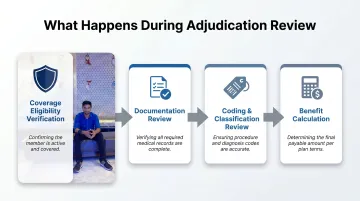
During adjudication, the payer performs several key checks:
- Coverage eligibility verification: Is the claimant's policy active? Does the claimed event fall within covered terms?
- Documentation review: Are submitted records complete and consistent?
- Coding or classification review: Is the service or repair correctly classified?
- Benefit calculation: How much is the payer liable for after applying deductibles, caps, or cost-sharing?
Two types of adjudication:
- Automated adjudication uses system-driven rule checks for straightforward claims
- Manual adjudication involves human reviewer oversight for complex or high-value claims
This distinction influences how quickly the determination is made.
In practice, Salesforce's Warranty Lifecycle Management platform triggers manual review when claim amounts exceed $1,000–$2,000 depending on product family, or when fault dates fall within three months of installation.
Traditional property and casualty (P&C) insurance processes only about 7% of claims through fully automated straight-through processing. Most still require some human intervention.
Does "adjudicated" mean "guilty"? In the context of insurance and warranty claims, "adjudicated" simply means "formally reviewed and decided." It carries no negative or harmful meaning. In a courtroom, the word can relate to guilt or fault, but in claims processing it's a neutral administrative term indicating the review is complete.
What Does "Awaiting Payment Cycle" Mean?
Payers—whether insurance companies, warranty administrators, or reinsurance entities—do not process individual payments the moment a claim is adjudicated. Instead, they batch payments together and release funds on a fixed schedule known as a payment cycle.
A typical payment cycle runs weekly, bi-weekly, or monthly. The cycle your claim falls into depends on when it was adjudicated relative to the payer's schedule cutoff.
For example, if your claim was adjudicated on a Tuesday and the payer runs weekly cycles every Friday, your payment would likely be included in that Friday's batch. If adjudication happened on Saturday, you'd wait until the following Friday.
What's Happening During the "Awaiting" Window
During this period, the payer is:
- Generating payment documentation (Explanation of Benefits or Electronic Remittance Advice)
- Preparing fund transfers (EFT or check)
- Finalizing amounts and reconciling accounts
This is back-office processing, not a sign of a problem with your claim.
"Awaiting Payment Cycle" vs. Other Statuses
It's important to distinguish "awaiting payment cycle" from similar-sounding statuses that represent very different stages:
Pending adjudication means the review has not happened yet. Claim adjudicated and awaiting payment means the review is complete and payment is queued (this is where you are). Claim paid means funds have been released.
Each status represents a distinct milestone in the claim lifecycle.
How Long Does "Awaiting Payment" Typically Last?
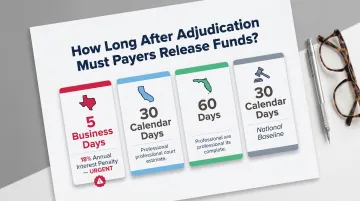
The NAIC Model Regulation 902 establishes a baseline for P&C insurance: after affirming liability, insurers must issue payment within 30 calendar days.
Virtually every U.S. jurisdiction has adopted this regulation. It serves as the standard timeline contractors and dealers should expect.
However, state prompt payment laws vary significantly:
| State | Payment Deadline After Acceptance | Notes |
|---|---|---|
| Texas | 5 business days | Shortest window; 18% annual interest penalty for delays |
| California | 30 calendar days | Standard timeline per CCR Title 10 |
| Florida | 60 days | For property insurance claims |
| NAIC Model 902 | 30 calendar days | Baseline adopted by most states |
Beyond regulatory deadlines, several practical factors affect how quickly you receive payment.
Variables That Determine Payment Speed
- Cycle frequency — Weekly cycles mean shorter waits than monthly cycles
- Adjudication timing — Claims adjudicated early in a cycle window are paid sooner than those processed just after a cutoff
- Payment method — EFT settles in 1–3 business days versus 5–10 days for paper checks (and costs $0.20–$1.50 per transaction vs. $4–$20 for checks)
- Secondary review triggers — High-dollar claims or potential fraud flags can extend timelines even after initial adjudication
When to Follow Up
If your claim remains in "awaiting payment" status beyond the payer's stated cycle window, contact the administrator for a status update and expected disbursement date. No cycle window communicated? Reach out anyway.
Industry data shows that 15–25% of claims team workload goes to payment status inquiries. Clear communication reduces this burden for everyone.
What to Do While Your Claim Is Awaiting Payment
While waiting for your claim payment to process, take these steps to ensure smooth disbursement:
- Note your claim reference number and verify the expected payment cycle date through your administrator's portal or by contacting the payer directly. Knowing the specific cycle cutoff helps set accurate expectations and tells you when follow-up is appropriate.
- Confirm your payment information is current with the administrator. Update banking details or mailing addresses now to avoid delays when disbursement is released.
- Track the payment cycle so you know exactly when to expect funds and when follow-up becomes necessary.
For contractors and dealers managing high claim volumes, these waiting periods highlight the value of direct oversight. Businesses that manage their own warranty programs through administrator-obligor reinsurance structures gain direct control over claims adjudication and payment timelines.
Instead of relying on third-party providers where status updates can be unclear and payment schedules harder to control, in-house administration provides full transparency. WarrantyRE helps clients establish this structure, handling claims adjudication as part of comprehensive administration while clients retain underwriting profits and maintain visibility from first call to final payout.
Frequently Asked Questions
What does it mean when a claim has been adjudicated and is awaiting the payment cycle?
The claim has been fully reviewed and a payment decision has been made in your favor. Funds are now queued for release on the payer's next scheduled disbursement cycle. No further action is required unless the cycle window passes without payment.
What does it mean when a claim is in adjudication?
"In adjudication" means the claim is actively being reviewed by the payer—eligibility, coverage terms, and documentation are being evaluated. A payment determination has not yet been issued, and no payment will be released until adjudication is complete.
What does 'pending adjudication' mean for my claim?
"Pending adjudication" signals the formal review has not yet begun or is still in progress. It's earlier in the pipeline than "adjudicated and awaiting payment," which confirms the review is already finished.
How long does claim adjudication typically take?
Straightforward claims can be adjudicated in 3 days with automation, while complex or high-value claims may take 21–45 days. Once complete, the "awaiting payment cycle" window depends on the payer's disbursement schedule.
What is a claim adjudication date?
The adjudication date is the official date on which the payer completed its review and issued a payment determination. This date is important for tracking payment cycle eligibility and for any appeals or disputes if payment does not arrive as expected.
Is 'adjudicated' the same as 'guilty'?
In insurance and warranty claims, "adjudicated" simply means "formally reviewed and decided"—it carries no negative meaning. In legal contexts it may relate to fault, but in claims processing it's a neutral term confirming the review is complete.