Introduction
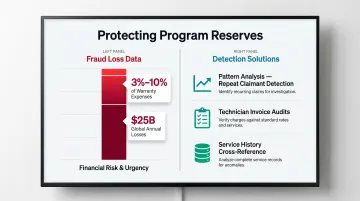
Poor claims adjudication costs warranty programs billions annually. Global warranty fraud losses hit $25 billion each year, with 3-10% of total warranty expenses lost to abuse, fraudulent payouts, and customer disputes.
Claims adjudication is the systematic process warranty administrators use to evaluate submitted claims and determine whether they're valid, covered, and eligible for reimbursement or repair authorization. For home service contractors and auto dealers running their own warranty programs, mastering this process directly impacts profitability.
This guide breaks down how claims are reviewed, what factors drive approval or denial decisions, and which best practices protect your program from fraud while maintaining customer satisfaction.
TLDR
- Adjudication determines which warranty claims get paid and protects your reinsurance profits
- Systematic review catches invalid claims while approving legitimate ones quickly
- Weak adjudication drains contractor and dealer profits through fraud, disputes, and unnecessary payouts
- Structured protocols protect your margins while maintaining customer satisfaction
- Speed, accuracy, and consistency define effective adjudication
What Is Claims Adjudication?
Claims adjudication is the formal evaluation process through which a warranty administrator or obligor (the entity responsible for paying claims) reviews a submitted claim and verifies it against policy terms. The administrator then determines the appropriate resolution—approval, partial payment, or denial.
This decision-making layer ensures only valid, covered claims get paid, authorizes the right repair or replacement cost, and protects warranty program reserves from improper use.
The process achieves three core objectives:
- Validating that claims meet policy requirements
- Authorizing appropriate repair costs based on actual damage
- Protecting program reserves from fraudulent or inflated submissions
Without structured adjudication, warranty programs lose money through unchecked payouts or frustrate customers through arbitrary denials.
Understanding this process requires distinguishing it from claims processing. Processing refers to the administrative handling and routing of claims data—entering information, assigning case numbers, and tracking status. Adjudication is the decision-making layer that determines whether a claim should be paid and how much. These are distinct but related steps in the warranty lifecycle.
Why Claims Adjudication Matters for Warranty-Based Businesses
For contractors and dealers running warranty or service contract programs, every claim approved or denied directly affects program profitability. An undisciplined adjudication process either bleeds reserves through unchecked payouts or frustrates customers through unnecessary denials.
U.S. manufacturers paid $30.37 billion in warranty claims in 2025, making claims adjudication quality a direct determinant of profitability.
The Financial Impact of Claims Decisions
The financial stakes are enormous. APQC benchmarking reveals a five-fold gap in warranty costs between top and bottom performers: 0.8% of sales versus 4.0% of sales. For a company with $2 billion in revenue, this gap equals $64 million.
Companies using advanced analytics reduce warranty costs to approximately 2% of sales, compared to 3.5% for companies relying on standard analytics.
Without a structured adjudication process, warranty programs risk:
- Fraudulent or inflated claims going unchallenged — dealer and service provider fraud in the U.S. was estimated at $2.6 billion in 2018
- Overlapping coverage getting double-paid — when multiple policies cover the same failure
- Patterns of high-cost claims never flagged — preventing root cause analysis and corrective action
Beyond controlling costs, proper adjudication directly impacts customer retention. When decisions are made fairly, documented clearly, and communicated promptly, customers trust the program. J.D. Power found that when service satisfaction reaches 950 or higher on a 1,000-point scale, 86% of mass market customers say they will definitely return for paid service.
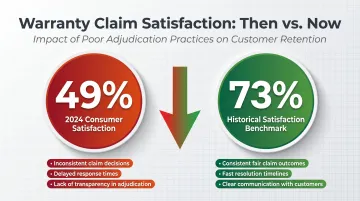
Contrast this with home warranty programs, where only 49% of consumers who filed a claim in 2024 were satisfied, down from 73% historically—a direct result of poor adjudication practices that deny claims arbitrarily or take weeks to respond.
How the Claims Adjudication Process Works: Step by Step
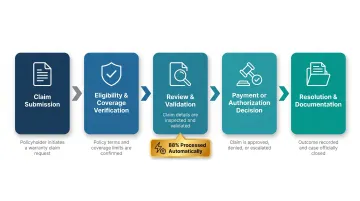
The adjudication flow moves through a series of validation, review, and decision checkpoints before reaching final resolution.
Each checkpoint catches a specific type of error or risk, protecting program reserves while ensuring legitimate claims are paid promptly.
Step 1: Claim Submission
The process begins when a customer or technician submits a warranty claim with all required information: customer and policy details, description of the failure or issue, relevant service or diagnosis codes, and the proposed repair or replacement. Incomplete submissions at this stage are the leading cause of delays and rejections downstream. Mismatched expectations cause 40% or more of future warranty headaches in homebuilder programs, often stemming from poor education at closing.
Required submission elements:
- Customer name and contact information
- Policy or contract number
- Date of failure or service request
- Detailed description of the issue
- Diagnosis or cause of failure
- Proposed repair or replacement
- Labor and parts cost estimates
Step 2: Eligibility and Coverage Verification
The administrator verifies whether the claim falls within the active coverage period, that the failed component or system is covered under the specific warranty tier purchased, and that no exclusions apply.
This acts as the first filter, removing claims that are clearly outside policy scope before further review resources are spent.
Verification includes:
- Confirming the policy is active and in good standing
- Checking that the failure date falls within the coverage period
- Validating that the failed component is listed in the covered systems
- Reviewing exclusions for pre-existing conditions, maintenance neglect, or unauthorized modifications
Step 3: Review and Validation
The claimed failure is assessed against the reported cause and proposed repair. APQC reports that the median company processes 88% of warranty claims automatically, using automated rule sets to flag inconsistencies—such as a repair cost that exceeds standard rates for the service type. Complex or high-dollar claims are escalated for manual review by an experienced adjudicator.
Review criteria include:
- Does the claimed failure match the diagnosis?
- Is the proposed repair appropriate for the diagnosed issue?
- Are labor rates within acceptable ranges?
- Do parts costs align with market pricing?
- Are deductibles and coverage limits applied correctly?
Prior authorization requirements, deductibles, and labor rate caps are applied here. Automated systems may flag claims exceeding certain thresholds—for example, claims over $2,000 for one product family or $1,000 for another—triggering manual review.
Step 4: Payment or Authorization Decision
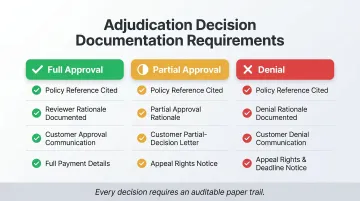
The adjudicator issues one of three outcomes: the claim is approved and payment or repair authorization is issued in full; it is partially approved with adjustments for non-covered costs or rate variances; or it is denied with a documented reason. Each outcome must be communicated clearly to the customer and the servicing technician or dealer.
Decision outcomes:
- Full approval — claim meets all policy requirements; full payment authorized
- Partial approval — claim meets policy requirements but includes non-covered costs; payment adjusted
- Denial — claim does not meet policy requirements; documented reason provided
Step 5: Resolution and Documentation
Once the decision is final, payment is issued or repair is authorized. Both parties receive documentation of the outcome. For denials or partial approvals, customers should receive a written explanation that includes the specific policy language that supports the decision. Clear documentation protects both parties during appeals or audits.
Documentation requirements:
- Policy reference and coverage tier
- Reviewer's rationale and decision criteria
- Communication sent to customer and provider
- Payment amount and authorization details
- Appeal rights and process (if applicable)
Among efficient homebuilder warranty programs, 90% of claims receive provider approval, with nearly 50% of repairs completed within one week—demonstrating that high approval rates with fast turnaround are achievable benchmarks.
Key Factors That Affect Warranty Claims Adjudication
Adjudication efficiency depends on multiple interconnected variables—from how contracts are written to how claims are screened. Understanding these factors helps warranty administrators identify bottlenecks and improve approval rates.
Contract Structure and Documentation
Policy clarity drives adjudication speed. Vague or ambiguous contract terms are the single biggest driver of disputed claims. The more precisely failure conditions, component lists, and exclusions are written, the easier and faster adjudication becomes.
92% of new car buyers mistakenly believe vehicle service contracts and insurance are the same product, creating confusion that fuels disputes.
Complete intake data prevents delays. Claims submitted with incomplete failure descriptions, missing diagnosis codes, or unverified customer policy numbers create bottlenecks that slow the entire review cycle. Clean submission data enables faster processing and reduces rejection rates.
Operational Factors
Adjudicator competency determines accuracy. Whether adjudication is handled internally or outsourced, the reviewer's experience determines whether high-dollar or edge-case claims are resolved correctly. Inconsistent decisions across similar claims create legal exposure and customer dissatisfaction.
Claim volume dictates workflow design. Programs with high claim volume benefit from automated rule-based adjudication for routine claims, reserving manual review for complex or high-cost cases. Without this triage approach, backlogs build and turnaround times suffer.
Risk Management
Fraud detection protects program integrity. Without screening mechanisms such as pattern analysis on repeat claimants, technician invoice audits, or cross-referencing service history, programs are vulnerable to inflated repair costs or fabricated failures.
Studies estimate that 3% to 5% of manufacturer revenue is lost to warranty and service abuse. Programs that build proactive fraud protocols reduce exposure while maintaining customer trust.
Common Misconceptions and Best Practices in Claims Adjudication
Misconception: Faster Approval Equals Better Customer Service
Many contractors and dealers assume that rubber-stamping claims without validation improves customer satisfaction. In reality, approving claims without proper review destroys program reserves and eventually forces price increases or program collapse.
Genuine customer satisfaction comes from fair, consistent, and clearly communicated decisions—not from blindly approving every submission.
Rejection vs. Denial: Know the Difference
A rejection happens before adjudication—the claim is returned because it is incomplete or incorrectly submitted. A denial happens after review—the claim was complete but found ineligible under the policy terms.
Conflating these two leads to poor tracking and missed opportunities to fix submission errors quickly.
Use a Structured Adjudication Checklist
A structured checklist removes subjectivity and speeds processing:
- Define criteria for approval at each coverage tier
- Create an auditable paper trail for every decision
- Ensure similar claims receive consistent treatment
- Reduce disputes and legal exposure through documentation
Documentation Is Non-Negotiable
Every adjudication decision—approval, partial, or denial—should be logged with the policy reference, the reviewer's rationale, and the communication sent to the customer. This protects the business during disputes and gives administrators the data to identify recurring claim patterns that signal product quality issues or fraud.
Partner with a Full-Service Administrator
For contractors and dealers who own their own warranty or reinsurance programs, partnering with a full-service administrator removes the operational burden while ensuring consistent, compliant decisions. WarrantyRE provides dedicated claims adjudication as part of its administration package, allowing business owners to capture warranty profits without managing claims complexity in-house.
Frequently Asked Questions
What is the purpose of claim adjudication?
Claim adjudication ensures only valid, covered claims are paid, protecting the warranty program's financial reserves while ensuring fair resolution under policy terms.
What are the steps in the claims adjudication process?
The five core steps are: claim submission, eligibility and coverage verification, claim review and validation, payment or authorization decision, and resolution with documentation.
What does a claims adjudicator do?
A claims adjudicator reviews submitted warranty claims against policy terms, validates the claimed failure and proposed repair, and issues an approval, partial approval, or denial. This ensures program reserves are protected while maintaining fair customer treatment.
What does 'pending claim adjudication' mean?
A claim in pending status has been received and is in the review phase—it has not yet received a final determination. This often occurs because additional documentation has been requested or the claim is awaiting manual review for complexity or cost thresholds.
What happens after a claim is adjudicated?
Once a decision is made, the approved amount is paid to the service provider or repair is authorized, the customer receives documentation of the outcome, and denied claims trigger a formal explanation that may include appeal rights. Proper documentation protects both parties and supports audit trails.
What are the three types of claim denials?
The three common denial categories are: coverage exclusion denials (the failure or component is not covered under the policy), administrative denials (the claim was submitted incorrectly or outside the required timeframe), and maintenance/negligence denials (the proposed repair is not warranted based on the diagnosed failure or stems from improper maintenance).