Introduction
Warranty-related rework takes up an average of 12.4% of total installed project cost across construction projects, according to the Construction Industry Institute. For electrical contractors operating on median net profit margins of just 5–6%, that rework percentage directly threatens profitability.
Every callback for a tripping breaker or panel connection that arcs after installation pulls billable technicians off new jobs. What should have been profit becomes uncompensated labor.
Warranty liability for electrical businesses extends beyond service calls. It affects technician utilization, creates margin pressure, and in serious cases escalates into legal claims involving property damage or personal injury.
The stakes are high. In 2023 alone, 142 worker deaths resulted from exposure to electricity, with construction and extraction occupations accounting for 52 of those fatalities. When a warranty dispute involves a panel installation linked to an arc flash incident, it becomes multi-thousand-dollar legal exposure.
Warranty liability is primarily driven by decisions and processes, not by the nature of electrical work itself. This article examines how liability accumulates at each stage—and three categories of proven strategies to reduce it.
TLDR
- Unclear terms, inconsistent work, poor documentation, and third-party programs drive warranty costs
- Express and implied warranties create obligations often broader than contractors intend
- Written terms, scope definitions, and site photos prevent disputes before work begins
- Quality checklists and photo documentation reduce callbacks and create defensible evidence
- Contractor-owned reinsurance turns warranty costs into controlled profit centers
How Warranty Liability Builds Up for Electrical Businesses
Warranty liability rarely appears as a single visible expense. It accumulates gradually through service callbacks pulling technicians off billable work, re-work labor that generates zero revenue, parts replacements not priced into the original job, and administrative time spent managing disputes.
When a journeyman electrician spends four hours diagnosing and repairing a panel connection that should have been torqued correctly during installation, that's four hours of lost billable revenue plus the cost of the callback itself.
Liability compounds when the scope of what was warranted was never clearly defined. Customers interpret verbal assurances broadly while contractors intend something narrower, and that gap creates conflict a written agreement would have prevented.
A contractor who verbally promises "we stand behind our work" may intend to cover only installation defects, while the customer expects coverage for any electrical issue that arises within the first year—including pre-existing conditions the contractor never touched.
Beyond cost disputes, electrical work carries inherent safety implications that can escalate a routine warranty dispute into a liability claim involving property damage or personal injury. Residential electrical malfunctions caused 23,700 fires in 2023, resulting in 305 deaths, 800 injuries, and over $1.5 billion in losses. A panel installation linked to a subsequent electrical issue stops being a service callback and becomes a multi-thousand-dollar legal exposure the moment property damage or injury enters the picture.
Key Drivers of Warranty Liability in Electrical Work
The Implied Warranty Gap
The single largest driver of warranty liability is the gap between implied warranty obligations and what is explicitly excluded in writing.
Under common law in virtually every state, contractors are presumed to warrant that their work is fit for its intended purpose and performed in a workmanlike manner, regardless of whether this is stated in writing.
Several states have established specific timelines for electrical work warranty obligations:
- Minnesota: 2-year warranty for electrical systems due to noncompliance with building standards
- California: 4-year limitations period for electrical system defects under the Right to Repair Act, with 10-year repose for latent defects
- Texas: 4-year statute of limitations for contract-based defect claims
- Florida: 7-year statute of repose as of July 1, 2024
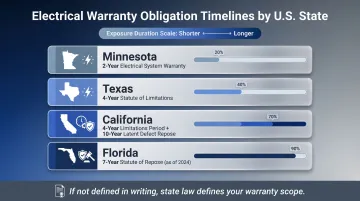
If a contractor is not defining their warranty scope in writing, state law is defining it for them—almost always more broadly than intended.
Workmanship Inconsistency Across Technicians
Why panel installations carry extreme liability:
- Improper torque on bus connections leads to arcing and overheating
- Incorrect wire sizing creates fire hazards
- Missing ground bonds eliminate critical safety protections
- Installation errors can trigger arc flash incidents with catastrophic consequences
These defects create both immediate callback costs and serious long-term legal exposure.
Over-Reliance on Third-Party Warranty Administrators
Beyond technical and legal risks, many electrical contractors unknowingly create financial liability through their warranty structure.
When contractors use third-party warranty programs, they surrender control over claims handling, cannot influence resolution speed or cost, and receive no share of the underwriting profit. The liability stays with the contractor while the profit goes to the administrator.
Extended warranty administrators in the AmTrust Financial segment reported loss ratios ranging from 63.6% to 77.0% between 2012 and 2017, with a five-year aggregate of 70.5%. That means roughly 23–36% of premium revenue was retained for overhead, administration, and profit before expenses—money that could have stayed with the contractor under a different structure.
Strategies to Reduce Warranty Liability for Your Electrical Business
Reducing warranty liability requires intentional action at three levels: the decisions made before work begins, the processes used during and after the job, and the structural arrangements that govern how warranty risk is held and funded. Each level compounds the one before it.
Strategies That Reduce Liability by Changing Pre-Job Decisions
Draft precise, written warranty terms for every job
Define the duration of the workmanship warranty, specify what types of failures are covered versus excluded (customer modifications, acts of nature, pre-existing conditions), and outline the resolution process. California's contractor warranty framework provides a useful model: for home improvement contracts of $500 or more, any warranty offered must be in writing and specify covered work and duration.
Written terms should explicitly address:
- Workmanship warranty duration (typically 1–2 years)
- Exclusions: customer modifications, misuse, normal wear, pre-existing conditions
- Resolution process: notice requirements, inspection procedures, remedy options
- Limitation of liability: maximum dollar amount or scope of coverage
Separate workmanship warranty from equipment warranty in all customer-facing materials
Equipment failures covered by manufacturers often end up on your desk instead of theirs. Understanding manufacturer warranty terms protects you from absorbing costs that aren't your responsibility.
Major electrical component manufacturers provide widely varying warranty durations:
| Manufacturer | Product Line | Warranty Duration |
|---|---|---|
| Eaton | Type BR loadcenters & breakers | 10 years |
| Eaton | CH loadcenters | Lifetime |
| Square D | Homeline load centers | 10 years |
| Square D | QO load centers & breakers | Lifetime |
| Siemens | Circuit breakers & SPDs | 2 years |
| Leviton | Wiring devices | 1 year (varies by product) |
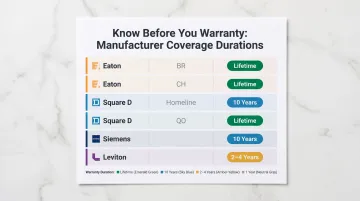
When contracts clearly distinguish "2-year workmanship warranty on installation" from "manufacturer warranty on equipment per manufacturer terms," customers understand who to contact for equipment failures—and contractors avoid absorbing costs that should be the manufacturer's responsibility.
Conduct and document pre-job site assessments
Photograph existing panel age, wiring condition, and any pre-existing code violations before work begins. Timestamped documentation of pre-existing conditions is the most efficient way to demonstrate that a post-installation issue falls outside warranty scope. A photo showing knob-and-tube wiring, aluminum branch circuits, or a 60-amp main panel before your service upgrade protects you when the customer claims "it worked fine before you touched it."
Strategies That Reduce Liability by Improving Job Execution and Documentation
Implement standardized technician quality checklists for each job type
Electrical work following a consistent documented checklist—covering panel connections, circuit load, grounding, and code compliance—produces fewer callbacks and creates a paper trail demonstrating workmanlike execution.
The financial impact is significant. Quality deviations account for 12.4% of total installed cost, while median electrical contractor net margins run just 5–6%. A single rework can consume an entire job's profit.
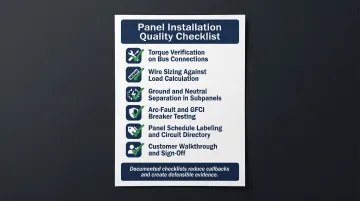
A panel installation checklist should include:
- Torque verification on all bus connections (per manufacturer spec)
- Wire sizing verification against load calculation
- Ground and neutral separation in subpanels
- Arc-fault and GFID breaker testing
- Panel schedule labeling and circuit directory
- Customer walkthrough and sign-off
Maintain thorough job-level documentation as standard practice
Photos taken before, during, and after installation, combined with customer sign-off at job completion, resolve the majority of ambiguous warranty disputes without requiring re-work or legal escalation. Document:
- Before: Existing conditions, panel interior, wire routing, equipment nameplate data
- During: Rough-in, concealed work before drywall, connections before panel cover
- After: Final installation, completed labeling, testing results
Modern smartphones make this documentation effortless. A 30-second video walkthrough of a completed panel interior provides more defensible evidence than any written description.
Invest in technician training tied to installation standards and callback tracking
Warranty callbacks are not evenly distributed—a disproportionate share often traces back to a small number of technicians or specific job types. Performance tracking by callback rate identifies and corrects recurring failure points before they compound into liability. When one technician generates callbacks on 15% of panel installations while the team average is 3%, that's a training issue, not a systemic problem.
Strategies That Reduce Liability by Changing the Structure Around Warranty Risk
Replace third-party warranty programs with a self-funded reinsurance model
Rather than paying premiums to a third-party provider who keeps the underwriting profit, electrical contractors can establish their own administrator obligor reinsurance company.
WarrantyRE helps electrical contractors build exactly this structure, where warranty fees flow into a contractor-owned reinsurance account, unused funds remain with the contractor as profit, and the reinsurance company is supported by A-rated insurers providing ultimate liability protection if claims exceed reserves.
Here's how it works:
- Warranty fee inclusion: A small warranty fee is built directly into job pricing (e.g., included in an $18,000 service upgrade bid)
- Fund flow: Collected fees deposit into the contractor's legally owned reinsurance account
- Claims coverage: When a warranty claim arises (tripping breaker, failed connection), funds from the reinsurance account cover the repair
- Profit retention: Unused funds remain the contractor's property, creating long-term financial benefit
- Tax advantages: Contributions to the reinsurance account reduce taxable income
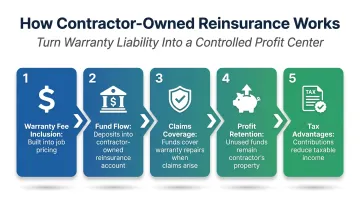
This structure converts warranty from an uncontrolled financial liability into a revenue stream the business actually controls. WarrantyRE handles all administrative tasks—claims management, program oversight, compliance, legal filings, and tax returns—allowing contractors to focus on their core work.
Build maintenance and service agreement programs that convert warranty cost into recurring revenue
Instead of treating the warranty period as pure liability, structuring service agreements that customers pay for annually funds future service calls from premium revenue rather than from margin. Combined with a reinsurance structure, this turns warranty work from a business expense into a profit-generating service line.
A 2-year labor warranty on a panel installation can be offered alongside an optional 5-year extended service agreement covering annual inspections, thermal imaging, and priority callback service. The service agreement premium flows into the reinsurance account, funding both the base warranty obligation and the extended coverage while generating profit on unused reserves.
Conclusion
Warranty liability for electrical businesses is shaped by decisions made long before a callback happens. The most effective approach works across three levels: written pre-job terms that define scope and exclusions, consistent job documentation and quality standards, and a structural warranty model that keeps risk and profit inside the business.
These three work together to transform warranty from a cost center into a controlled asset.
The third level: how warranty risk is held and funded, is where contractors most often leave money on the table. Owning your warranty structure converts liability into a revenue stream you control.
WarrantyRE helps electrical contractors establish reinsurance programs backed by A-rated insurers, handling compliance, claims adjudication, and financial administration while you capture the underwriting profit. Instead of paying third-party providers, you build equity in your own warranty company funded by your customer base.
Ready to stop leaving warranty profits on the table? Let's explore how reinsurance fits your business model.
Frequently Asked Questions
How can an electrical contractor reduce warranty liability?
Use a three-level approach: written pre-job terms that define scope and exclusions, consistent documentation and quality standards, and a structural warranty model like contractor-owned reinsurance. Each level compounds the effectiveness of the others.
How long is a contractor liable for their work?
Liability duration depends on state law and written warranty terms. Most states impose statutes of limitations ranging from 2–6 years, with some requiring specific electrical system warranties. Written terms can extend or limit this timeline.
What is covered under an electrical warranty?
Workmanship warranty covers your installation to code and professional standards. Equipment warranty covers manufacturer obligations on panels, breakers, and devices. Without written terms, customers may expect both to be your responsibility.
What is a limitation of warranty liability?
A limitation of warranty liability is a written contract provision that caps the contractor's financial obligation—defining the maximum duration, dollar amount, or scope of coverage they will honor, and excluding specific causes of failure such as customer modifications, misuse, or pre-existing conditions.
Do electricians have liability insurance?
Most states require or strongly recommend general liability insurance for licensed electrical contractors. General liability covers bodily injury and property damage but does not replace a well-structured warranty program. Warranty reinsurance provides a complementary layer of financial protection specifically for warranty claims.
What is the general liability code for electrical contractors?
Electrical contractors typically fall under NCCI class code 5190 (electrical work within buildings) or related codes depending on the scope of work. These codes determine general liability premium rates, and managing warranty-related claims can directly affect loss history and insurance costs over time.