Introduction
Picture this: you're sitting at the dealership finance desk, paperwork stacked in front of you, and the F&I manager mentions "bumper-to-bumper warranty" and "powertrain warranty" back-to-back. You nod along, but internally, you're wondering what actually separates the two.
Understanding this difference matters beyond the sales conversation. It directly affects which repairs get covered, when coverage runs out, and what out-of-pocket costs you could face if a major component fails.
According to J.D. Power's 2025 Initial Quality Study, infotainment systems alone generate 42.6 problems per 100 vehicles—the single most problematic category. That's covered by bumper-to-bumper, not powertrain. Meanwhile, a transmission replacement averages $5,892-$6,402—a powertrain expense that could hit you years after your bumper-to-bumper expires.
TL;DR
- Comprehensive coverage protects nearly all components for 3 years/36,000 miles, excluding wear items
- Powertrain protection covers engine, transmission, and drivetrain for 5-10 years/60,000-100,000 miles
- Exclusionary coverage lists what's NOT included; everything else is assumed covered
- After factory warranties expire, extended coverage decisions become critical to avoid full repair costs
- Neither warranty covers maintenance, wear items, accident damage, or misuse
Bumper-to-Bumper vs. Powertrain Warranty: A Quick Comparison
| Feature | Bumper-to-Bumper | Powertrain |
|---|---|---|
| Coverage Scope | Nearly all vehicle components: electrical, climate control, steering, suspension, infotainment, brakes, body components | Engine, transmission, drivetrain only: engine block, cylinder heads, transmission/transaxle, transfer case, axle shafts, universal joints |
| Typical Duration | 3 years/36,000 miles (industry standard); some luxury brands offer 4 years/50,000 miles | 5 years/60,000 miles (industry standard); competitive brands offer 10 years/100,000 miles |
| What's Excluded | Wear items (tires, brake pads, wiper blades, bulbs), maintenance, accident damage, misuse, glass, upholstery | Sensors, wiring, radiators, cooling lines, belts, hoses, any non-powertrain component |
| Type of Warranty | Exclusionary: defines what's NOT covered | Named-component: specifies only what IS covered |
| Best Suited For | Early ownership period when electronics and tech components fail due to manufacturing defects | Mid-to-long ownership period protecting against catastrophic mechanical failures |
Manufacturer Variations:
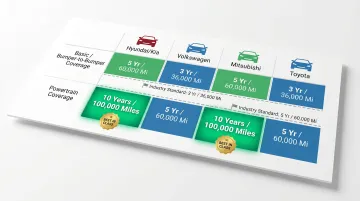
- Hyundai, Kia, Mitsubishi: 5 years/60,000 miles basic, 10 years/100,000 miles powertrain
- Volkswagen: 6 years/72,000 miles for both bumper-to-bumper and powertrain
- Toyota: 3 years/36,000 miles basic, 5 years/60,000 miles powertrain (industry baseline)
What Is a Bumper-to-Bumper Warranty?
A bumper-to-bumper warranty—also called a basic or comprehensive warranty—is an exclusion-based warranty. The contract lists only what is NOT covered; everything else between the front and rear bumpers is assumed to be included.
Consumer Reports defines it as "the primary warranty, which covers all nonwear items and ensures that the car operates like new while it is in effect."
What's Covered
Bumper-to-bumper warranties typically cover:
- Electrical components: alternators, wiring, power windows, power seats, sunroofs
- Climate control: AC compressor, heating systems
- Steering and suspension: power steering pumps, shock absorbers, control arms
- Infotainment and navigation: touchscreens, audio systems, onboard computers
- Braking systems: ABS modules, brake boosters (not pads or rotors)
- Body components: door locks, mirrors, trim pieces
What's Excluded
Most bumper-to-bumper warranties exclude:
- Wear-and-tear items: tires, brake pads, wiper blades, light bulbs, clutch linings, filters (these degrade with normal use)
- Glass and upholstery: windshields, windows, seats, carpeting
- Wheels: rims, wheel bearings
- Damage from external causes: accidents, environmental damage (hail, flooding), misuse, unauthorized modifications, neglected maintenance
Some manufacturers offer limited coverage for wear items. Hyundai, for example, covers wear items for 1 year/12,000 miles, including belts, brake pads and linings, clutch linings, filters, wiper blades, bulbs, and fuses.
Typical Duration
The industry standard is 3 years/36,000 miles, whichever comes first. Many luxury brands extend this to 4 years/50,000 miles. Hyundai, Kia, Genesis, and Mitsubishi stand out with 5-year/60,000-mile basic warranties—significantly above average.
Extended Bumper-to-Bumper Coverage Cost
Once the factory warranty expires, you can purchase an extended service contract. Fortegra's 2025 industry data shows the average cost is $1,281, though prices vary based on:
- Vehicle make, model, age, and mileage
- Coverage level and term length
- Whether it's manufacturer-backed or third-party
- Deductible amount
OEM extended warranties tend to have minimal deductibles (rarely exceeding $200) and allow repairs at any authorized dealer. Third-party contracts may cost less but come with stricter repair facility limitations and higher deductibles, according to Edmunds.
What Is a Powertrain Warranty?
A powertrain warranty covers only the core mechanical components that generate and deliver power to the wheels. Unlike bumper-to-bumper, it's a named-component warranty—it specifies exactly what IS covered, not what isn't.
What's Covered
Powertrain warranties typically include:
- Engine: block, cylinder heads, pistons, bearings, crankshaft, camshaft, internal engine parts, seals, and gaskets
- Transmission/transaxle: internal transmission components, torque converter, transmission case
- Transfer case: (on 4WD/AWD vehicles) internal components and case
- Drivetrain: propeller shafts (driveshafts), universal joints, constant velocity joints, axle shafts, differentials
Toyota's official warranty language specifies that powertrain coverage is "60 months/60,000 miles and includes engine, transmission/transaxle, front-wheel-drive system and rear-wheel drive system."
What's Excluded
Powertrain warranties do NOT cover:
- Sensors and wiring (even those connected to the engine or transmission)
- Radiators, cooling lines, hoses
- Belts (timing belt, serpentine belt)
- Engine mounts
- Exhaust systems
- Fuel systems (pumps, injectors)
- Turbochargers and superchargers (on some warranties)
Because fewer components are covered, powertrain warranties can extend much longer than comprehensive coverage. The parts included are engineered for durability.
Typical Duration
The industry standard is 5 years/60,000 miles. However, competitive manufacturers use extended powertrain warranties as selling points:
- Hyundai markets "America's Best Warranty" with 10 years/100,000 miles powertrain coverage—but only for original owners. Second owners get 5 years/60,000 miles.
- Kia offers the same 10-year/100,000-mile structure, available to original purchasers and certified pre-owned buyers.
- Mitsubishi brands its program "America's Best-Backed Vehicles" with identical 10-year/100,000-mile powertrain coverage, non-transferable after the first owner.
Why Powertrain Coverage Outlasts Bumper-to-Bumper
These extended timeframes make sense when you consider repair costs. Powertrain failures are severe and expensive.
RepairPal data shows transmission replacement averages $5,892-$6,402. J.D. Power reports engine replacement costs range from $2,000-$10,000 depending on make and model.
Manufacturers extend powertrain coverage to:
- Signal confidence in their engineering and build quality
- Protect buyers from the highest-cost repairs
- Differentiate themselves in competitive segments (particularly economy and midsize vehicles)
Key Differences Between the Two Warranties
Scope: Wide vs. Deep
Bumper-to-bumper is wide but shallow. It protects against a broad range of defects during early ownership. Powertrain is narrow but deep, focused on the most expensive mechanical systems that can fail over time.
Example scenario: Your infotainment screen freezes at 25,000 miles. That's covered under bumper-to-bumper, not powertrain. Your engine develops a bearing failure at 55,000 miles. That's covered under powertrain (if still active), but bumper-to-bumper has expired.
The "Gap Window"
Here's where confusion happens: when bumper-to-bumper expires but powertrain remains active, only powertrain components are covered. Everything else becomes out-of-pocket.
On a typical Ford or Chevy (3-year/36,000-mile basic, 5-year/60,000-mile powertrain):
- Miles 0-36,000: Both warranties active—nearly everything covered
- Miles 36,001-60,000: Only powertrain covered—electrical, AC, steering electronics, infotainment, suspension all out-of-pocket
- Miles 60,001+: No factory coverage—everything out-of-pocket
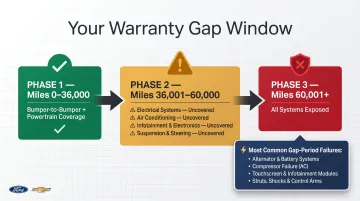
This gap is often misunderstood by car buyers who assume "I still have warranty" means comprehensive coverage.
What Fails When
Understanding which components fail when helps explain why the gap window matters. J.D. Power's 2025 Initial Quality Study found that infotainment generates 42.6 problems per 100 vehicles—the single most problematic category.
Half of all top industry problems are infotainment-related. Touchscreens now control climate, garage door openers, and even glove box releases.
Key insight: The components most likely to fail early—electronics, sensors, and tech features—only the shorter bumper-to-bumper warranty covers, not the longer powertrain warranty.
Situational Recommendations
Bumper-to-bumper is most valuable:
- In the first 3 years of ownership
- For vehicles with complex electronics and connectivity systems
- When manufacturing defects in tech components are most likely to surface
Powertrain warranty is higher-stakes protection:
- In the mid-ownership phase (years 3-10)
- Against major mechanical failures that cost thousands
- For buyers planning to keep vehicles long-term
For dealers: Clearly communicating these differences builds trust and improves the customer experience at the service desk. For buyers, understanding which warranty covers a repair determines whether you pay out-of-pocket or not.
What Happens When Both Factory Warranties Expire?
Once both warranties run out, you're fully responsible for all repair costs. This is the coverage cliff—and it can be expensive.
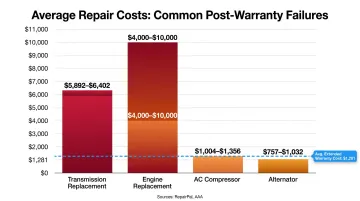
Common Post-Warranty Repair Costs
| Repair | Average Cost |
|---|---|
| Transmission replacement | $5,892-$6,402 |
| Engine replacement | $4,000-$10,000 |
| AC compressor replacement | $1,004-$1,356 |
| Alternator replacement | $757-$1,032 |
Sources: RepairPal (January 2026) and AAA (2024 data). AAA notes that average car repair costs increased by as much as 32% from September 2019 to September 2023.
Extended Service Contracts: The Primary Solution
The FTC defines the difference clearly:
- A manufacturer's warranty is included in the vehicle price and is a promise to fix defects during a specific timeframe.
- A vehicle service contract (often called an "extended warranty") is a separately purchased optional contract—"not a warranty as defined by federal law."
You can purchase extended service contracts from:
- Manufacturers (OEM extended warranties)
- Third-party providers (independent warranty companies)
- Dealerships offering in-house programs
Dealer-Administered Reinsurance Programs
Auto dealers can offer their own in-house extended warranty programs through reinsurance models. Companies like WarrantyRE help dealers establish these programs to provide reliable coverage beyond the factory period.
This approach offers several advantages:
- Captures warranty profits that would otherwise go to third-party providers
- Controls the claims process and directs service revenue back to dealer facilities
- Provides customized coverage tailored to inventory and customer base
Customers receive comprehensive coverage with a streamlined claims experience. Dealers retain the financial benefits of warranty sales within their business.
The growing adoption of dealer-administered programs reflects broader market trends.

Market Growth
The vehicle service contract market was valued at $32.86 billion in 2024 and is projected to reach nearly $50 billion by 2032, according to 360iResearch data cited by Fortegra.
Conclusion
Bumper-to-bumper and powertrain warranties serve different purposes at different points in the ownership lifecycle. Neither replaces the other—they're complementary layers of manufacturer protection. Bumper-to-bumper guards against early-life defects in a wide range of components, while powertrain protects against catastrophic mechanical failures over a longer period.
Savvy buyers should understand both before signing. Know when each warranty expires, what the gap window means for your wallet, and which systems lose coverage first.
Whether you're a car buyer evaluating coverage options or a dealer looking to structure warranty programs, knowing where one warranty ends and another begins is the foundation of making smart decisions. For dealers, this knowledge becomes especially valuable when establishing reinsurance programs that allow you to offer extended coverage while capturing the profits typically paid to third-party providers.
Understanding factory warranty limitations is the natural starting point for evaluating extended coverage. With average costs around $1,281 and repair bills ranging from hundreds to thousands of dollars, base your decision on three factors: your vehicle's reliability history, your risk tolerance, and how long you plan to keep the car.
Frequently Asked Questions
What does a bumper-to-bumper limited warranty cover?
A bumper-to-bumper warranty covers most vehicle components—electrical systems, climate control, steering, suspension, infotainment, and brakes. Wear-and-tear items like tires, brake pads, wiper blades, and maintenance services are excluded.
What is excluded from a bumper-to-bumper limited warranty?
Common exclusions include consumables (tires, brake pads, bulbs, filters), damage from accidents or misuse, maintenance services (oil changes, tune-ups), glass, upholstery, and environmental damage.
Is a bumper-to-bumper limited warranty worth it?
Factory bumper-to-bumper warranties are included at no extra cost and provide valuable early-ownership protection. For extended coverage, value depends on your vehicle's age, reliability history, and tolerance for out-of-pocket repair costs.
How much does a 100,000-mile bumper-to-bumper limited warranty cost?
The average extended warranty costs around $1,281, though comprehensive contracts extending to 100,000 miles typically range from $1,500 to $3,000 or more. Costs vary by provider, vehicle make, model, age, and mileage.
How does a 10-year/100,000-mile bumper-to-bumper limited warranty work?
Coverage remains active until the vehicle reaches the mileage or year limit, whichever comes first. Manufacturer warranties with these terms often apply only to original owners, with reduced coverage (typically 5 years/60,000 miles) for subsequent owners.