Introduction
Picture this: Your HVAC system fails on the hottest day of summer. You pull out your extended warranty, confident you're protected — only to discover the $1,200 repair comes with a $750 labor charge that isn't covered. Or worse, the warranty reimburses labor at $75/hour while your local technician charges $135/hour, leaving you to cover the $60/hour gap.
This scenario plays out thousands of times daily across automotive shops, HVAC service calls, and appliance repair visits nationwide.
The core tension? Most consumers assume "extended warranty" means comprehensive coverage, but the fine print tells a different story — especially when it comes to labor costs.
This guide breaks down when extended warranties cover labor, what determines coverage, and which contract terms matter most.
Whether you're a homeowner buying protection or a home service contractor offering warranty programs, understanding labor coverage gaps can save thousands of dollars and prevent customer disputes.
TLDR:
- Most manufacturer warranties cover parts only, not labor — you pay the technician
- Extended service agreements fill the labor gap left by parts-only warranties
- Labor coverage varies by industry — auto bumper-to-bumper includes it, while HVAC manufacturer warranties exclude it universally
- Even when labor is covered, contracts often cap reimbursement below actual shop rates
- Contractor-owned warranty programs (backed by reinsurance) eliminate rate cap problems by letting contractors set their own terms
The Short Answer: Do Extended Warranties Cover Labor?
It depends — and that answer hinges on three critical variables: the warranty type (manufacturer vs. third-party extended), the specific contract language, and the industry (auto, HVAC, home appliances).
Parts-Only vs. Parts-and-Labor: The Critical Distinction
The FTC draws a clear line under the Magnuson-Moss Warranty Act: a "full" warranty must provide service "free of charge," including labor. A "limited" warranty may cover "only parts and not labor."
Here's what that means in practice:
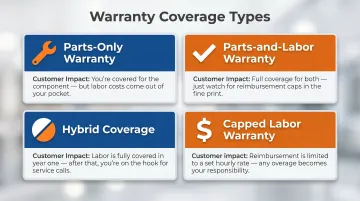
- Parts-only warranty: You receive the replacement component free, but pay the technician's hourly rate for diagnosis and installation
- Parts-and-labor warranty: Both the component and installation time are covered (subject to contract terms and caps)
- Hybrid coverage: Some warranties cover labor only during the first year, then parts-only afterward
- Capped labor: Reimbursement limited to specific hourly rates or time estimates
Most standard manufacturer warranties are limited and parts-only. For example, a 10-year parts warranty on an HVAC compressor doesn't mean the homeowner pays nothing when it fails — they still owe the contractor $400-$800 in labor to swap out the failed part.
What "Labor Coverage" Actually Means
In warranty terms, labor coverage means reimbursement for the technician's time to diagnose and repair or install the covered component, which typically includes diagnostic work to identify the failure, removal of the failed part, installation of the replacement component, and testing/system startup.
Covered labor activities include:
- Diagnostic time to identify the failure
- Removal of the failed part
- Installation of the replacement component
- Testing and system startup
True extended labor warranties — often called Extended Service Agreements (ESAs) — are specifically designed to fill the gap left by manufacturer parts-only warranties.
Coverage Is Rarely Unlimited
Even when labor IS covered, expect limitations:
- Hourly rate caps: Contracts may reimburse $75/hour when local shop rates are $135/hour
- Time limits: Repairs are capped using industry labor guides (e.g., Mitchell, ALLDATA)
- Deductibles: Per-claim fees of $100-$125 are common
- Pre-authorization requirements: Work must be approved before you begin
Types of Extended Warranties and How Each Handles Labor
Manufacturer Warranties (Factory Warranties)
Labor coverage: NO (with rare exceptions)
Manufacturer warranties typically cover defects in materials and workmanship for a set period but exclude labor costs for in-field repairs after installation. This pattern is standard across HVAC, appliances, and most home equipment.
Example: Carrier, Trane, Lennox, and Rheem all provide parts-only limited warranties on residential HVAC equipment. According to Carrier's warranty FAQ, "Carrier provides a limited parts warranty but not labor coverage. Labor costs are managed by your dealer or contractor."
The result? A homeowner who bought a $12,000 HVAC system with a 10-year parts warranty still pays $600-$1,200 in labor when the compressor fails in year seven.
Automotive Bumper-to-Bumper Warranties
Labor coverage: YES (during the base warranty period)
Auto manufacturers consistently include labor in their bumper-to-bumper new vehicle warranties. Chevrolet's warranty explicitly covers "repairs, including parts and labor" for 3 years/36,000 miles.
This creates a sharp contrast with the home services industry and sets consumer expectations that "warranty = parts + labor" — expectations that get frustrated when those same consumers encounter HVAC or appliance warranties.
Powertrain Extended Warranties (Auto)
Labor coverage: PARTIAL
Powertrain warranties cover the cost of parts and associated labor for engine and drivetrain repairs — but only for the listed components. Supporting repairs (hoses, fluids, gaskets, sensors) needed alongside the covered repair often fall outside coverage.
Third-party Vehicle Service Contracts (VSCs) vary widely. Endurance Warranty's contract defines covered costs to include "the usual and fair charges for parts and labor," but caps repair time using standard industry labor guides. Plans extend up to 84 months and 100,000 miles.
Extended Service Agreements (ESAs) for Home Services
Labor coverage: YES — this is their primary purpose
Unlike the automotive warranties above, ESAs bridge the gap in home services. They cover labor on component failures, since the manufacturer warranty already handles parts. This is the clearest form of "labor warranty."
How they work:
- The installing contractor sells the ESA at installation
- The homeowner pays a warranty fee (built into the job price or sold separately)
- When a covered failure occurs, the contractor submits a claim and receives reimbursement for labor
Common ESA terms for HVAC: 1, 2, 3, 5, or 10 years. Lennox offers its Comfort Shield ESA in 3-, 5-, 7-, 10-, or 12-year terms (12-year only for Signature Collection). Rheem's Protection Plus program provides "parts & labor coverage on mechanical and electrical failures."
Contractor-Owned Warranty Programs (Reinsurance Model)
Labor coverage: YES — and contractors set the terms
An alternative structure is emerging in the home services space: contractors run their own warranty programs backed by reinsurance.
Instead of selling a third-party ESA, the contractor includes a warranty fee in the job price, deposits it into their own reinsurance account, and pays claims from that account.
Key advantage: The contractor defines the labor rates and coverage terms, eliminating the gap between what a third party reimburses and what the contractor actually charges.
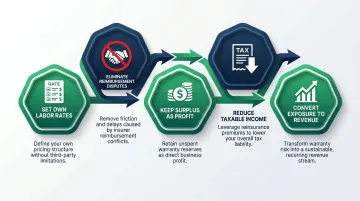
This is where WarrantyRE helps home service contractors (HVAC, plumbing, electrical, roofing) build their own reinsurance model:
- Contractors set labor reimbursement rates that match actual shop rates
- Third-party reimbursement disputes are eliminated
- When claims run lower than fees collected, contractors keep the surplus as profit
- Contributions to the reinsurance account reduce taxable income
- Warranty exposure becomes a revenue opportunity
When Labor Is NOT Covered: Common Exclusions to Know
Even contracts that include labor coverage exclude specific scenarios. Understanding these limits prevents claim denials.
Routine Maintenance and Wear Items
Always excluded:
- Oil changes, filter replacements, tire rotations
- Brake pad replacements, wiper blades
- HVAC tune-ups, coil cleaning
- Scheduled maintenance items
Warranties cover unexpected failures, not scheduled upkeep. If you skip recommended maintenance, you may void coverage entirely.
Improper Installation or Faulty Workmanship
Beyond routine maintenance, installation quality also affects coverage.
ESAs do not protect against installation errors by the original contractor. If a technician installs a component incorrectly and it fails, that's a workmanship issue — not a covered warranty claim. This is a critical distinction for contractors offering warranties: your ESA covers component failures, not your own installation mistakes. Those remain your liability under separate workmanship warranty obligations.
Acts of God and Lack of Maintenance
Common exclusions from Choice Home Warranty's user agreement:
- Flooding, lightning strikes, earthquakes
- Damage from neglect or misuse
- Pre-existing conditions (known or unknown)
- Building code violations
- Cosmetic damage
Critical for homeowners: Document your maintenance records. If you can't prove you changed the filter or scheduled annual service, the warranty company may deny your claim.
Predictive Failures (Not-Yet-Failed Components)
The final major exclusion category affects preventive service.
Most ESAs won't reimburse for proactive labor to replace a part that's degrading but hasn't failed yet. Coverage typically kicks in only after failure occurs.
This creates a challenge for contractors trying to help customers avoid full breakdowns. A technician who spots a failing capacitor during a tune-up can't bill the labor to replace it under warranty until it actually fails.
The limitation stands even though replacing it now would prevent a more expensive emergency call later.
The Labor Rate Cap Problem: Fine Print That Catches People Off Guard
The labor rate cap is where warranty coverage promises collide with real-world costs.
The Gap Between Wages and Shop Rates
According to the Bureau of Labor Statistics, automotive technicians earn a median wage of $22.96/hour (May 2023). Yet AAA reports that actual shop billing rates range from $120 to $159/hour for nearly half of all repair shops, with dealerships charging 25% or more above independent shops.
Why the gap? Shop rates must cover:
- Technician wages
- Facility rent and utilities
- Diagnostic equipment and tools
- Insurance and licensing
- Training and certifications
- Overhead and profit margin
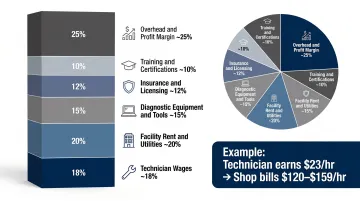
A technician earning $23/hour generates revenue at 4-6x that rate.
How Rate Caps Play Out in Practice
Many extended warranties specify a maximum hourly reimbursement (e.g., $75/hour) or tie reimbursement to "established industry time and labor guides."
When your local shop charges $135/hour, you pay the $60/hour difference — even on a "covered" repair.
Endurance Warranty's contract states: "The maximum allowance for covered repair time is governed by established industry time and labor guides." When the guide allows 2.5 hours and the shop bills 3.5 hours, you pay for the extra hour.
A credit union VSC guide warns: when a repair facility uses a different labor guide than the VSC provider, "the member pays the difference."
Total Reimbursement Caps
Beyond hourly rate restrictions, some contracts limit total labor payout per claim or per year.
A $3,000 annual cap may sound generous until you need a full HVAC system replacement with $2,500 in labor costs plus refrigerant and ductwork modifications — suddenly you're thousands over the limit.
Takeaway: Look at total reimbursement potential, not just the stated hourly rate.
Labor Warranty Coverage by Industry
Auto/Automotive
Manufacturer warranties: Include labor at dealerships during the base warranty period (typically 3 years/36,000 miles bumper-to-bumper; 5 years/60,000 miles powertrain).
Most third-party vehicle service contracts (VSCs) include labor on covered component repairs, but with important limitations:
- CARCHEX pays repair facilities directly; most drivers pay $1,500-$2,500 for a used car VSC
- Coverage terms extend up to 84 months and 100,000 miles
- Labor reimbursement uses flat-rate guides that may not match actual shop billing
According to Consumer Reports (October 2025), "Past CR member surveys showed that car owners typically paid more for the coverage than they got back in direct benefits."
HVAC and Home Services
Manufacturer parts warranties typically cover components for 5-10 years. However, labor is excluded in all cases.
| Manufacturer | Registered Parts Warranty | Labor Included? | Extended Labor Option |
|---|---|---|---|
| Trane | 10 years | NO | Some dealers offer 1-year installation labor warranty |
| Lennox Signature | 12 years | NO | Comfort Shield ESA: 3-12 years labor |
| Carrier | Extended with registration | NO | Dealer ESAs available |
| Rheem | Extended with registration | NO | Protection Plus ESA |
To bridge this gap, many contractors offer extended labor warranties (ESAs) that run 1-10 years. Under traditional ESA models, contractors submit claims post-repair and receive reimbursement for labor on covered failures.
Some contractors use a reinsurance model that eliminates third-party rate caps. This approach allows them to:
- Set labor rates that match actual shop charges
- Include warranty fees in job pricing upfront
- Pay claims from their own reinsurance account
- Maintain full control over claims administration and compliance
Home Appliances
Manufacturer extended warranties typically extend the OEM parts warranty on a single appliance. Labor is often excluded after the first year.
Home warranty plans take a different approach. They cover multiple systems and appliances, including both parts and labor, but impose significant per-claim caps.
| Provider | HVAC System Cap | Appliance Cap | Service Fee |
|---|---|---|---|
| American Home Shield (ShieldGold) | $5,000/system | $2,000/appliance | $100-$125 |
| American Home Shield (ShieldPlatinum) | $5,000/system | $4,000/appliance | $100-$125 |
| Choice Home Warranty | $3,000/item/12 months | $3,000/item/12 months | Varies |
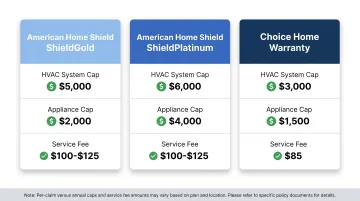
The home warranty market reached $4.6 billion in 2025, growing at 3.9% annually. However, regulatory enforcement is increasing: Arizona's Attorney General secured an $11.8 million settlement against Choice Home Warranty in February 2026 for claim denials and misrepresented coverage.
What to Look for in a Warranty Contract for Labor Coverage
Before signing any extended warranty, ask these critical questions:
Coverage Verification:
- Does the contract explicitly state labor is covered?
- Is it labeled "full" or "limited" under Magnuson-Moss standards?
- What specific components and systems are covered?
Rate and Cap Analysis:
- What is the hourly labor rate cap?
- Does the contract use industry labor guides? Which ones?
- Are there per-claim or annual labor payout limits?
- What are local shop rates in your area — and does the contract cover them?
Administrative Requirements:
- Is pre-authorization required before repairs begin?
- Is there a deductible per claim?
- Who pays if the actual labor exceeds the guide allowance?
Transferability and Cancellation:
- Can the warranty transfer to a new homeowner?
- What are the cancellation terms and refund policies?
The FTC's Consumer Checklist
The FTC advises consumers to evaluate:
- The initial cost vs. hidden costs (deductibles, service fees)
- Who is offering the warranty (manufacturer or third party)
- What limitations apply (accidental damage, maintenance requirements)
- Whether putting money in savings might be a better option
For Contractors: Matching Coverage to Real-World Costs
For contractors offering warranties, the challenge is clear: third-party reimbursement rates often fall below actual shop rates. This gap forces contractors to either absorb the difference or bill customers directly—neither option is ideal.
One alternative is contractor-owned reinsurance programs. By building their own warranty structure, contractors control reimbursement rates and ensure they match real-world labor costs. Programs like those administered by WarrantyRE handle claims processing, compliance, state licensing, and financial reporting, allowing contractors to focus on installations while capturing warranty underwriting profits.
This approach eliminates reimbursement disputes and converts warranty offerings from a cost burden into a controlled revenue stream.
Frequently Asked Questions
Do warranties cover labour?
Manufacturer warranties typically cover parts but not labor. Extended warranties and ESAs can cover labor only if the contract explicitly includes it. Always verify whether the warranty is labeled "full" (labor included) or "limited" (may exclude labor).
What do extended warranties not cover?
Extended warranties exclude routine maintenance, wear-and-tear items (brake pads, wiper blades), damage from misuse or acts of God, pre-existing conditions, and predictive replacements. Most contracts also exclude cosmetic damage and require documented maintenance records.
How long is a labor warranty?
Labor warranty durations vary by industry and provider. In HVAC, ESA terms commonly range from 1 to 10 years; in auto, labor coverage under a VSC typically matches the contract term (2-7 years).
What does a limited warranty cover?
A limited warranty covers only what is explicitly named in the contract — usually specific parts or components — and typically excludes labor, maintenance, cosmetic damage, and anything resulting from misuse or lack of maintenance.
Is $100 an hour fair for mechanic labor?
$100/hour is at the low end of the national range for automotive labor. AAA reports that nearly half of all repair shops charge $120-$159/hour, with dealerships charging 25% or more above independent shops. Many extended warranty contracts cap reimbursement near $100/hour, meaning customers may owe the difference even on covered repairs.