
Introduction
Manual warranty claims handling creates a cascade of operational problems for home service contractors and auto dealers: technicians wait hours for approval callbacks, customers grow frustrated with slow response times, and inconsistent coverage decisions spark disputes that erode trust.
These delays directly cut into the profit margin that warranty programs are designed to protect. According to industry research, businesses processing claims manually spend 40-60% more time per claim than those using automated systems, driving up administrative costs while slowing customer resolution.
Claims process automation uses technology to handle warranty and service contract claims from intake through resolution with minimal manual intervention.
When you own your warranty program through a reinsurance structure, automation becomes a strategic advantage: you control the adjudication rules, set the approval logic, and capture the efficiency gains—rather than leaving that control with a third-party provider. When you own the program, you own the process.
TL;DR
- AI, RPA, and digital workflows resolve claims faster with fewer errors
- Reduces manual callbacks and speeds technician dispatch while controlling costs
- Covers intake, validation, adjudication, and payment stages
- Program ownership gives you control over automation rules
What Is Claims Process Automation?
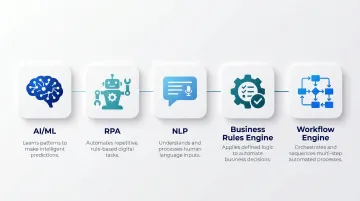
Claims process automation uses digital tools—including AI, machine learning, robotic process automation (RPA), and business rules engines—to handle repetitive, rule-based steps in the claims lifecycle without requiring human intervention at every stage.
The result: faster claim resolution, lower administrative costs, fewer errors in coverage decisions, and a consistent customer experience.
Many businesses mistake digitization for automation. Digitization replaces paper with online forms and email notifications—a necessary first step. Automation goes much further.
It connects intake, eligibility checks, approval logic, dispatch, and payment into a continuous, automated workflow. The system interprets data, applies rules, flags exceptions, and moves claims forward without manual handoffs.
Core Technologies Driving Automation
Key technologies include:
- AI and machine learning for decision-making, predictive analytics, and fraud scoring
- RPA for repetitive tasks like data entry and system updates
- Natural language processing (NLP) to extract data from invoices and service logs
- Business rules engines for automated approval decisions based on coverage terms
- Workflow engines to assign tasks, trigger approvals, and manage escalations
Why Warranty and Home Service Businesses Need Claims Automation
Manual warranty claims create specific operational pain for contractors and dealers. Technicians waste time waiting on approval callbacks. Customers experience slow response times and inconsistent coverage decisions.
Administrative staff manually enter duplicate claim data, chase missing documentation, and struggle to identify patterns of abuse or excessive claim frequency.
What goes wrong without automation:
- Missed service level agreements (SLAs) damage customer satisfaction
- Duplicate claim entries and manual errors lead to overpayments
- Inability to spot fraud patterns or excessive claims
- Inconsistent adjudication creates disputes and erodes trust
The Financial Impact of Manual Processing
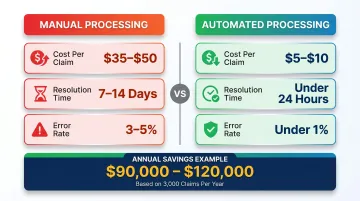
Industry benchmarks show that manual operations cost $35–$50 per claim to process, compared to $5–$10 for top performers using automation. For a contractor processing 3,000 claims annually, that's a difference of $90,000 to $120,000 in administrative costs alone.
The speed gap compounds these costs. Manual operations average 7–14 days to resolve claims, while automated systems close claims in under 24 hours.
Manual operations produce 3–5% error rates on claims costs, while automated systems reduce errors to under 1%. For a mid-size operation with $1.2 million in annual payouts, a 3% error reduction saves $36,000 per year.
The competitive stakes extend beyond cost. Customers who experience a slow or disputed warranty claim are unlikely to renew service contracts or recommend the contractor—directly impacting recurring revenue. Customer satisfaction scores increase by 15–25 points when claims resolve in under three days.
Contractors and dealers who own their reinsurance-backed warranty program—rather than outsourcing to a third-party provider—control both the adjudication rules and claims experience, making automation implementation more straightforward. Under WarrantyRE's full-service administration model, clients retain control over claims processing decisions while the company handles claims adjudication and administrative execution.
How Claims Process Automation Works: A Step-by-Step Breakdown
Automation connects the key stages of a warranty claim end-to-end, from the moment a customer reports a problem to the point a technician is paid.
The system draws from multiple data sources:
- Customer and contract information
- Coverage terms and deductible status
- Historical claim patterns
- Technician availability and service area
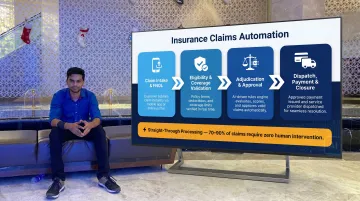
Step 1: Claim Intake and FNOL
The process begins when a customer submits a claim through a digital portal, mobile app, or automated phone intake. The system logs the incident, collects details about the issue, and confirms the customer's contract is active. Digital intake replaces phone-based processes with guided claim submission, reducing manual data entry and accelerating the start of the claims lifecycle.
Step 2: Eligibility and Coverage Validation
The system automatically cross-references the submitted claim against coverage terms, deductible status, and claim history to determine whether the repair or service is covered. Straightforward claims move forward immediately; the system flags exceptions for human review rather than stalling the entire workflow.
Manual lookup and phone tag—typical culprits behind approval delays—are removed from the equation entirely.
Step 3: Adjudication and Approval
Predefined rules and AI-assisted logic determine whether to approve the claim outright, request additional information, or route it to a human adjuster. Straightforward claims—such as a covered HVAC part replacement or a standard plumbing repair—move to approval without manual intervention.
Key benefits of straight-through processing:
- Faster customer resolution times
- Reduced adjuster workload on routine claims
- Consistent application of coverage rules Top-performing organizations achieve 70–90% straight-through processing (STP) rates, meaning the majority of claims never require human intervention.
Step 4: Dispatch, Payment, and Closure
Approved claims trigger technician dispatch or direct payment to a service provider, with automated notifications keeping the customer updated. The system then closes the claim and logs it for reporting and fraud pattern analysis.
Manual payment reconciliation is cut out, and audit-ready records are generated automatically for compliance tracking.
Key Factors That Affect Claims Automation in Warranty Programs
Success with claims automation depends on several operational and technical factors. Understanding these variables helps you implement the right solutions for your warranty program.
Several factors determine how effectively automation can be implemented in a warranty program:
Data quality and contract completeness: Automation is only as accurate as the coverage data it draws from. Contracts with missing terms or unclear exclusions produce inconsistent automated decisions. Clean, structured data on VINs, service dates, part numbers, and repair histories is essential for AI-driven decisions.
Claim volume and complexity: High-volume, low-complexity claims—such as standard part replacements or scheduled maintenance disputes—work best for straight-through automation. Complex or disputed claims still need human judgment, but automation ensures they're routed to the right adjuster with complete information.
Integration with existing systems: Automation tools must connect to dispatch software, payment systems, and contractor management platforms. Poor integration creates bottlenecks that negate speed gains. Purpose-built warranty platforms reduce implementation time from 6–12 months to 30–60 days through pre-built integrations.
Regulatory and compliance requirements: Reinsurance-backed warranty programs must maintain audit-ready records of every claim decision. NAIC Model Law 685 requires that providers maintain records for three years after contract expiry. Built-in governance features are non-negotiable for any automation platform.
Common Misconceptions About Claims Process Automation
Automation Eliminates Human Judgment
Effective claims automation routes routine claims through automated workflows while flagging exceptions for review. Adjusters remain essential for complex, disputed, or high-value claims.
Munich Re Specialty notes that "the future of claims is not about eliminating human involvement, but about redesigning the process so that expertise and automation work in tandem."
Only Large Carriers Can Afford Automation
Home service contractors and auto dealers running their own warranty programs can implement targeted automation on specific steps—intake, eligibility checks, payment triggers—without enterprise-scale systems. The warranty claims automation market reached $5.3 billion in 2024 and is projected to grow to $15.7 billion by 2033, driven largely by cloud-based platforms that eliminate high upfront IT infrastructure costs.
Specialized mid-market platforms are designed for teams outgrowing spreadsheets, with enterprise-grade features but without enterprise complexity.
Automation Guarantees Faster Approvals
Even with the right tools in place, automation doesn't guarantee faster approvals—it ensures claims move through the right steps consistently. Poorly configured rules can slow things down or produce incorrect coverage denials.
Setup and adjudication logic must be thoughtfully designed. That's why working with an experienced administrator like WarrantyRE, who understands both the technology and the warranty business, is critical for contractors and dealers managing their own reinsurance programs.
Frequently Asked Questions
What is automated claims processing?
Automated claims processing uses AI, RPA, and digital workflows to handle repetitive claim steps from intake to payment. It reduces manual effort, speeds resolution, and improves accuracy by applying consistent rules while flagging exceptions for human review.
What are the 4 stages of process automation?
The four stages are intake (collecting claim details), validation (verifying coverage eligibility), adjudication (approving or routing based on rules), and payment/closure (settling with the service provider and recording outcomes).
Will AI take over claims processing?
AI automates repetitive and rules-based tasks but does not replace human adjusters on complex or disputed claims. The realistic outcome is that adjusters handle fewer routine cases and focus on nuanced decisions that require judgment, relationship management, or specialized expertise.
Are claims management companies legit?
Legitimate companies operate under regulatory compliance and maintain transparent adjudication records. Look for full-service administration with audit trails and no hidden fees. Owning your own reinsured warranty program gives you direct control over claims outcomes and profitability.
What types of warranty claims are best suited for automation?
High-volume, low-complexity claims with clear coverage rules—such as standard part replacements, maintenance disputes, or service call verifications—are ideal candidates. These claims have predictable patterns and well-defined terms that can be encoded into business rules.