

This article breaks down typical warranty administrator fee structures, cost ranges, what drives prices up or down, and the hidden costs contractors frequently overlook when evaluating warranty administrators.
TL;DR
- Administrators charge through per-contract fees, premium percentages, flat monthly rates, or hybrid models
- Costs vary by service level, contract volume, and whether claims adjudication is included
- Setup fees, monthly admin costs, and claim processing charges add up quickly
- The bigger question: how much warranty profit stays in your business versus going to the administrator
- WarrantyRE's reinsurance model lets contractors own their warranty company and capture 100% of profits
What Do Warranty Administrators Charge Contractors?
Warranty administration for contractors is not a fixed-price service. Costs depend on fee structure, program size, services bundled, and the administrator's business model.
When contractors misunderstand these costs, they underestimate ongoing expenses, lock into unfavorable contracts, or discover that the administrator is capturing a far larger share of warranty revenue than expected.
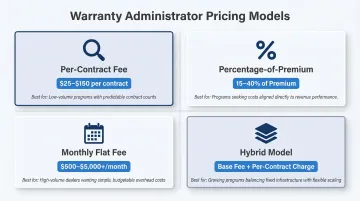
Three primary pricing models are used by third-party warranty administrators:
Per-Contract Fee Model
Under this structure, the administrator charges a flat fee for each warranty contract issued or activated—typically ranging from $25 to $150 per contract depending on coverage level. This fee covers basic claims processing, customer service, and minimal compliance support.
Advanced services are usually add-ons:
- Detailed financial reporting and analytics
- Multi-state compliance management
- Contractor and staff training programs
- Custom branding and marketing materials
Best for: Lower-volume operations or contractors just launching a warranty program. The predictable per-contract cost makes budgeting straightforward, but expenses scale quickly as volume grows.
Percentage-of-Premium Model
Some administrators take a percentage of the total warranty premium collected from the customer rather than a flat fee—typically 15% to 40% of each premium. The admin's income grows alongside your warranty revenue, which can eat into contractor profit margins over time.
Why this matters: As your program scales, the administrator's share scales with it. Home warranty marketers typically see margins of 30% to 45%, and much of that margin is captured by administrators under percentage-based models.
This model creates a misalignment: the administrator profits whether claims are managed efficiently or not, while contractors bear the reputational and financial risk of poor claims handling.
Monthly or Annual Flat-Fee Model
This structure involves a recurring monthly or annual fee—typically $500 to $5,000+ per month—that covers administration regardless of contract volume.
What's typically included:
- Basic tier: Claims intake and processing only
- Mid tier: Adds compliance management and basic reporting
- Full-service tier: Complete administration including customer service, financial reporting, and staff training
Best for: Contractors with predictable, consistent warranty volume who want cost certainty. This model eliminates per-contract variability but requires sufficient volume to justify the fixed cost.
Hybrid Fee Structures
Many administrators combine a base monthly fee with a per-contract or per-claim charge. This is common among full-service administrators. Contractors should calculate the blended cost per contract before committing, as the total can exceed what either standalone model would cost.
Key Factors That Drive Warranty Administration Fees
Warranty admin pricing is shaped by operational, contractual, and program-specific variables. Understanding them helps contractors compare quotes on an apples-to-apples basis.
Scope of Services Included
The biggest cost driver is what the admin actually does. Basic admins may only process claims, while full-service admins handle:
- Claims adjudication and approval
- Compliance filings and state registrations
- Performance reporting and financial reconciliation
- Staff training and onboarding
- Customer service and dispute resolution
The broader the scope, the higher the fee—but also the lower the risk of compliance exposure or operational failure.
Program Volume and Scale
Contract volume affects pricing significantly. Administrators often offer tiered pricing where higher-volume programs pay lower per-contract fees.
Small contractors launching a new warranty program may face higher per-unit costs until volume thresholds are met.
Claims Frequency and Risk Profile
Programs with higher-risk installations—such as older equipment or high-repair-rate systems—may carry higher admin fees because claims adjudication is more labor-intensive. In 2023, 24% of homeowners reported HVAC breakdowns, 21% washer/dryer breakdowns, and 21% indoor plumbing/fixtures failures.
High claim frequency directly impacts administrative workload and pricing. The contractor warranty landscape reflects broader industry pressures:
- HVAC system repair/replacement costs have inflated 40.5% since 2020
- 5.5 million U.S. homes surpassed the 15-year-old mark in 2023, increasing the likelihood of major system failures
- An ACCA survey found 30-35% of individual HVAC service contracts operate at a net loss when fully loaded costs are accurately allocated
Compliance and Regulatory Requirements
Warranty programs operating across multiple states require administrators to manage state-level licensing, filings, and contract language compliance. Contractors whose programs span multiple markets should expect higher admin fees than single-state operators.
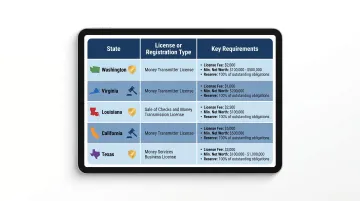
Regulatory complexity varies dramatically by state:
| State | Requirement | Key Details |
|---|---|---|
| Washington | Service contract provider registration | $250 application fee; $200 annual renewal; $200,000 minimum net worth; 40% funded reserve or reimbursement insurance |
| Virginia | Home service contract provider license | $500 annual fee; 40% self-funded reserve on gross provider fees minus claims |
| Louisiana | Home service contract provider registration | $600 initial application; $250 renewal |
| California | Home Protection Company License | Issued by CA Department of Insurance |
| Texas | Residential Service Company license | Regulated by TX TDLR |
Full Cost Breakdown: Beyond the Monthly Admin Fee
The monthly or per-contract admin fee is rarely the only cost. The total cost of working with a warranty administrator includes several line items that contractors must account for when evaluating program profitability.
Setup and Onboarding Fees
Many administrators charge a one-time fee to establish the contractor's program, create contract templates, register with state regulators, and onboard staff. These fees can be significant, though specific published ranges are not widely available.
Some providers waive setup fees to win business, but contractors should clarify what's included and whether waived fees result in higher ongoing costs.
Ongoing Administration Fees
These are the monthly, annual, or per-contract fees that represent the ongoing operating cost of the program. Most contractors focus exclusively on these fees, but they represent only part of the total picture.
What ongoing fees typically cover:
- Basic claims intake and processing
- Customer service inquiries
- Minimal compliance support (not comprehensive program management)
Claims Processing and Adjudication Costs
Some admins charge separately for each claim processed or adjudicated. This can be a flat fee per claim or a percentage of the claim value. Contractors with high claim volume should calculate total projected claims costs, not just base admin fees.
For example, if your program generates 100 claims annually and the admin charges $50 per claim, that's an additional $5,000 in annual costs beyond the base administration fee.
Compliance, Reporting, and Financial Management Fees
Compliance management—state filings, contract renewals, tax returns—and financial reporting/bookkeeping may be bundled or billed separately.
The absence of these services from a lower-cost admin doesn't eliminate the need for them; it simply shifts the cost burden to the contractor.
Key compliance costs include:
- State registration fees (recurring annually or biennially)
- Funded reserve requirements (40% of gross consideration less claims paid in many states)
- Reimbursement insurance policy premiums (if using this compliance path)
- Legal and tax filing fees
Low-Cost vs. Full-Service Warranty Administrators: What's the Difference?
Not all administrators are equal. The gap between a low-cost admin and a full-service admin often shows up not in the fee structure but in what gets left undone.
Services and Support Depth
Lower-cost admins typically handle basic claims intake and processing. Full-service admins manage the entire program:
- Claims review and approval
- Contractor training and onboarding
- Compliance filings and state registrations
- Financial reporting and bookkeeping
- Customer service and dispute resolution
A bare-minimum admin leaves contractors exposed to compliance violations, poor customer experiences, and unresolved claims disputes. These issues don't appear in the fee schedule but can result in program shutdown, regulatory penalties, or lost customer trust.
Claims Handling Quality and Speed
Service quality differences become obvious when claims hit. Claim approval times, dispute resolution, and payout reliability differ significantly between lower-tier and full-service administrators.
Nearly 60% of consumers expect warranty or return-related issues to be resolved within 24-48 hours. A slow or inconsistent claims process damages the contractor's customer relationship, not just the admin's reputation.
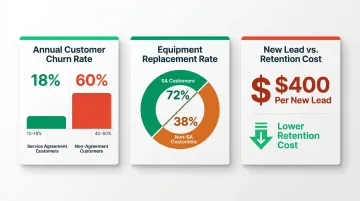
The customer retention numbers tell the story:
- Service agreement customers churn at 12-18% annually vs. 40-60% for non-agreement customers
- SA customers have a 72% equipment replacement rate vs. 38% for non-agreement customers
- The cost to generate a single new lead for a contractor is approximately $400, making retention through warranty programs significantly more cost-effective
Long-Term Value and Program Profitability
These service differences translate directly to profitability. A higher-fee full-service admin may actually produce a better financial outcome for the contractor by reducing compliance risk, minimizing claim leakage, and supporting program growth.
The comparison should focus on total cost of ownership, not just monthly fees.
What Most Contractors Miss When Evaluating Warranty Admin Costs
Focusing Only on the Headline Fee
Most contractors compare admins on monthly rate or per-contract cost without calculating total cost across the full fee structure. This leads to underbudgeting and surprises after launch.
A $25/contract admin that charges separately for claims processing, compliance, and reporting may cost more than a $40/contract admin that bundles everything.
Ignoring Who Actually Owns the Warranty Profit
Third-party administrators are not just service vendors. They often capture substantial warranty premium revenue that contractors generated.
The admin's fee model directly determines how much of the contractor's warranty income stays in their own business versus flowing to the administrator. Some contractors address this by establishing their own administrator-obligor reinsurance company, allowing them to retain underwriting profits and unused warranty funds rather than paying an external administrator indefinitely.
Overlooking Compliance Exposure
Contractors who choose a low-cost admin that does not manage state filings, contract language, or regulatory compliance are taking on legal and financial risk that does not appear in any fee schedule.
This can result in penalties or program shutdown. For example, Maryland imposes a $5,000 penalty for unauthorized sales of mechanical repair contracts. Multi-state operators face compounding compliance requirements across jurisdictions, each with different registration fees, reserve requirements, and filing deadlines.
Frequently Asked Questions
What is a warranty administrator?
A warranty administrator processes claims, verifies coverage, approves repairs, and manages compliance obligations for warranty programs. This company is distinct from the one that sells or markets the warranty.
What is a warranty service fee?
A warranty service fee (also called a trade call fee or deductible) is a charge paid by the customer when a claim is filed. From a contractor's perspective, this is distinct from the administrative fees they pay to operate their warranty program.
Do warranty administrators make commission?
Many administrators earn a percentage of warranty premiums, per-contract fees, or both—effectively taking commission on each warranty sold. Understanding this fee structure is critical to evaluating program profitability.
How much does a third-party warranty cost?
Costs vary significantly by program type, trade category, and coverage scope. More importantly, contractors should evaluate how much premium they retain after administration fees, claims, and compliance costs are deducted.
What should contractors look for when comparing warranty administrators?
Evaluate total fee structure (not just base fees), services included, claims handling track record, and compliance support. Most importantly, determine whether the model lets you capture meaningful warranty profit or primarily benefits the administrator.